
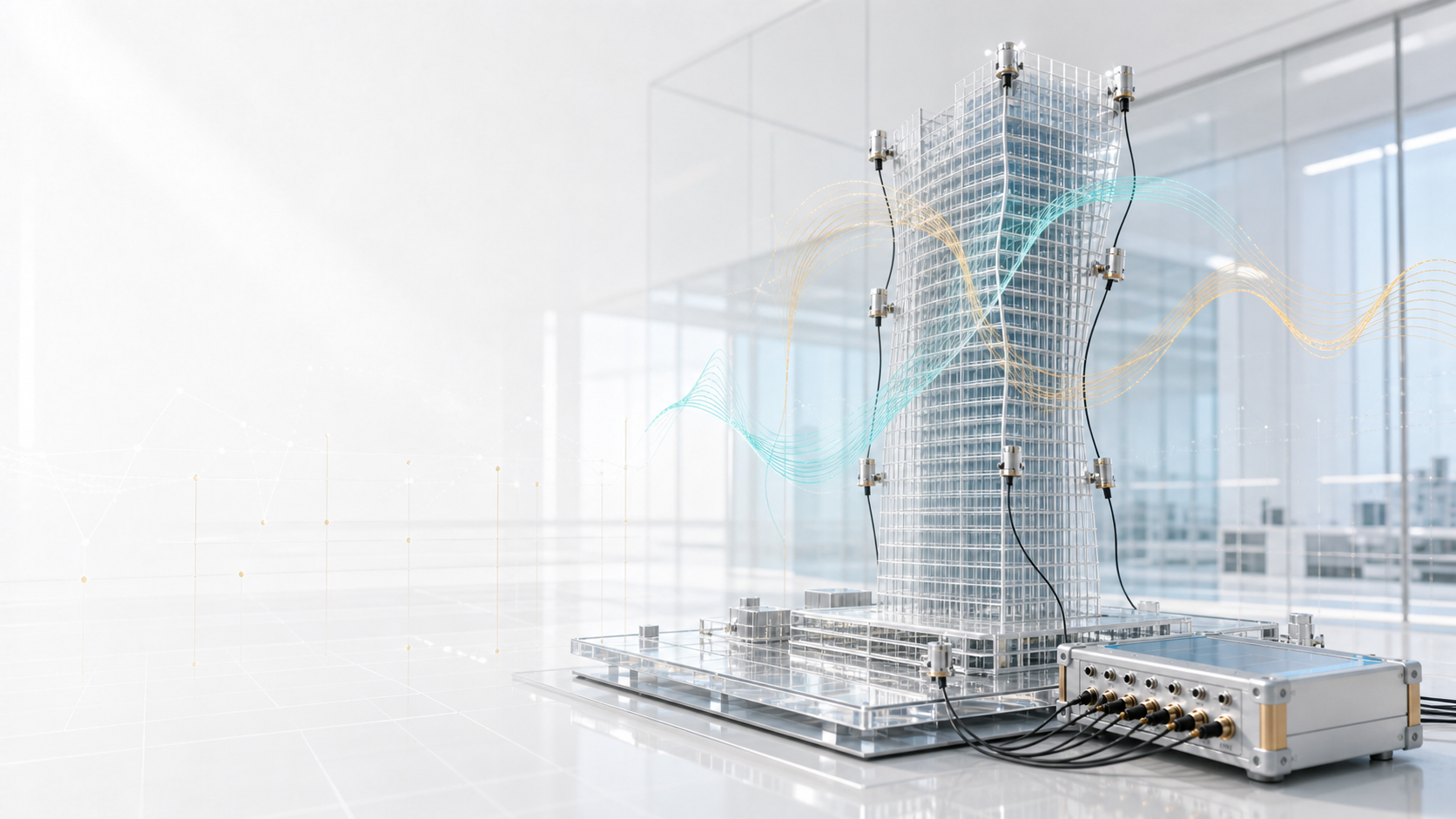
Structural tower model in a studio setting

The product family

One discipline.
Five instruments.

Structural dynamics is not one job. Identification, monitoring, forced-response testing, benchmark generation, and code-based assessment each get a purpose-built product — connected where it matters by documented data handoffs, and nowhere else.

01 — The instruments

Purpose-built. Each one.

Flagship · OMA

Modal Master

Operational modal analysis for engineers who answer for their results. CURRENT v1.0 CAPABILITY

The defensible-identification OMA platform: eight identification engines, the closed-loop Deep Estimate, per-mode evidence trails, analytic uncertainty, HVSR site characterization, a full spectral-analysis bench, and branded reporting — on the desktop, on-premises. Its 3D visualization animates 800,000-node models at 60 Hz as measured on the development GPU, with headroom beyond a million nodes on stronger hardware.

The current v1.0 release covers measured-data OMA, review, visualization, and reporting. NExT/ERA/NExT-ERA (v1.1), Hilbert damping (v1.2), TOMA (v1.3), CWT damping (v1.4), nonlinearity diagnostics (v1.5), Bayesian Identification (v1.6), Stationarity & Event Analysis (v1.7), Physical Mode Scaling (v2.0), FE Correlation (v2.1), and Batch Runner (v2.2) are planned future capabilities and are not currently available. Direct FE import and native FE solving remain deferred without a release version.

  • 8 identification engines
  • Deep Estimate
  • HVSR / SESAME
  • 7 spectrum tools
  • 3D: 800k nodes @ 60 Hz
  • Parametric geometry
  • PDF · DOCX reports
  • EN + TR
Monitoring

Modal Master SHM

Continuous structural health monitoring — the always-on sibling. SHIPPING · v1.2

Where Modal Master analyzes a campaign, SHM watches a structure: streaming FDD with batch SSI-COV re-identification, mode tracking that keeps physical modes matched across time (Hungarian assignment), environmental normalization to separate temperature from damage-relevant change, Hotelling T² statistical alarming, and a structure-level health index built for owners, not just analysts.

  • Streaming FDD
  • Batch SSI-COV
  • Mode tracking
  • Environmental normalization
  • Hotelling T²
  • Health index
Forced-response testing

Modal Master EMA

Experimental modal analysis from measured FRFs — hammer and shaker work. WORKING PRODUCT · EVALUATION BY ENGAGEMENT

When you control the excitation, EMA is the tool: the full FRF estimator set (H₁, H₂, H₃, H​v, H​s) with coherence, impact-testing windows, CMIF mode indication, circle and line fitting, and its own identification pair — Peak Stabilization and Balanced ERA — with UFF 55/58 interchange for the lab ecosystem you already run.

  • H₁–H​s estimators
  • Coherence
  • Impact windows
  • CMIF
  • Circle / line fit
  • Peak Stabilization
  • Balanced ERA
  • UFF 55/58
Benchmark & simulation

Modal Master Signal Generator

Synthetic structural response with exact ground truth — the family's proving ground. SEPARATE DOWNLOAD · CONTACT FOR CURRENT BUILD

Every claim the family makes about accuracy traces back here: a generator that synthesizes multi-channel structural response — 18 structural presets, five excitation types, up to 64 channels — and writes the exact modal ground truth beside every dataset as JSON. Console automation scripts entire corpora; an EN 13791-oriented concrete path serves assessment workflows. It is the machine that builds the machines' exams.

  • 18 presets
  • 5 excitation types
  • 64 channels
  • Ground-truth JSON
  • Console automation
  • EN 13791 concrete path
Seismic assessment

CIVIA

Code-based building assessment driven by measured dynamics. WORKING PRODUCT · EVALUATION BY ENGAGEMENT

CIVIA turns identified modes into engineering judgment: building assessment under the Turkish seismic code (TBDY 2018), driven by measured modal properties instead of assumed ones. It consumes Modal Master's .mmoma.json export directly — the committed, evidence-backed mode set becomes the input to the assessment, with its provenance intact.

  • TBDY 2018
  • Measured-modal input
  • .mmoma.json ingest
  • Assessment reporting
02 — How they connect

Documented handoffs.
Nothing else.

Each product is its own purpose-built codebase. Where they cooperate, they cooperate through documented data formats — three real handoffs, drawn exactly as they exist.

Modal Mastercommitted modes
.mmoma.json
CIVIATBDY 2018 assessment
Signal Generatorground-truth datasets
CSV + truth JSON
Modal Mastercertification benchmark
Signal Generatorlive multi-channel stream
live stream
Modal Master SHMmonitoring pipeline exercise

The committed OMA result flows into assessment with its provenance intact; synthetic ground truth flows into certification; simulated streams exercise the monitoring pipeline before a single sensor is installed. These three arrows are the family's integration story — drawn honestly, because a diagram is a claim too.

A monitoring service, a test bench, and an identification desk are different jobs with different failure modes. We build them as separate instruments on purpose — each one small enough to be answerable for what it does.

— Why a family, not a monolith

Family briefing

Tell us the job.
We'll bring the instrument.

Campaign identification, continuous monitoring, lab EMA, benchmark corpora, or code-based assessment — we will demonstrate the product that fits, on data like yours.

Enterprise evaluations · Technical dossiers under NDA · Volume licensing

Request a briefing